




Choosing between a tankless water heater vs regular water heater involves more than comparing efficiency ratings. The right system depends on your household’s hot water demand, installation requirements, maintenance needs, and long-term operating costs.
This guide explains the main differences between a tankless water heater vs regular water heater, including performance, lifespan, upfront cost, and overall practicality. Here is a quick look at the key factors to consider when deciding which water heater is better for your home.
Schedule a Water Heater Assessment
Tank or Tankless: Which Water Heater Fits Your Central Texas Home?
Do you want the simplest replacement, or are you optimizing for long-term comfort and efficiency? Choosing between these two systems depends on your household’s peak demand and how long you plan to stay in your Austin or Round Rock home.
A Quick Checklist for Making Your Choice
- Choose a tank if you need the fastest, lowest-cost replacement with the fewest plumbing retrofits.
- Choose tankless if you value endless showers, need to reclaim closet space, and want a system that lasts twice as long.
- Consider a heat-pump heater if you want maximum energy efficiency and have ample space for a larger footprint.
While a tank is a reliable traditional choice, tankless retrofits are the new standard for local families tired of running out of hot water mid-shower. Knowing which fits your lifestyle is the first step toward a permanent solution.
Tankless Water Heater vs. Regular Water Heater: Understanding the Mechanism
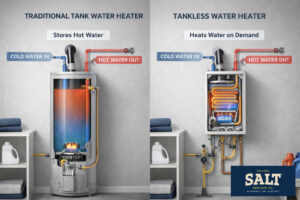
Have you ever wondered why a tankless unit is the size of a carry-on suitcase while a regular heater looks like a massive metal barrel? The difference comes down to whether you are managing a fixed inventory of heat or generating it in real time.
Regular Water Heater
A standard tank heater acts like a giant thermos. It stores 40 to 50 gallons of water and keeps it at a steady 120°F around the clock. When you turn on a faucet, hot water is drawn from the top while cold water enters the bottom to be reheated. This design is simple and provides a reliable buffer for short bursts of high demand, but it consumes energy 24/7 to combat standby loss.
Tankless Water Heater
A tankless unit stays off until you open a tap. It uses high-BTU gas burners or heavy-duty electrical elements to flash-heat water as it travels through a heat exchanger. This eliminates standby loss, which can save 10% to 20% on monthly water heating costs. However, performance depends entirely on the flow rate and the temperature of the incoming water.
Both systems are available in gas and electric configurations. Central Texas homeowners should note that whole-home electric tankless units are extremely demanding. These often require significant electrical panel upgrades to handle 120 to 150 amps of dedicated power.
Now that the mechanics are clear, let’s talk about the biggest performance myth: “unlimited hot water.”
The Math Behind Endless Hot Water: Sizing Your Tankless System
Tankless water heaters provide “endless” hot water only up to the unit’s maximum capacity. While the marketing sounds like magic, the supply is only endless if the heater can keep up with the speed of the water flowing through it. If you draw 7 gallons per minute (GPM) through a unit rated for 5 GPM, you will not run out of water, but you will certainly run out of heat.
To avoid lukewarm showers, you must understand temperature rise. This is the mathematical difference between your desired temperature (usually 120°F) and the temperature of the water entering your home from the ground.
The Formula: Temperature Rise = 120°F – Inlet Water Temperature
In Central Texas, groundwater typically ranges from 65°F to 75°F. During a February cold snap in Hutto or Round Rock, that inlet temperature can drop to 50°F or lower. A unit that provides 8 GPM in the summer might only deliver 5 GPM in the winter because it must bridge a 70-degree temperature gap.
When sizing your system, don’t guess based on square footage or “family of four” rules. Calculate your peak simultaneous demand instead. Start by checking your fixture labels or using these common estimates:
- Standard Shower: 2.5 GPM
- Kitchen Faucet: 1.5 GPM
- Dishwasher or Washing Machine: 1.0 to 2.0 GPM
If your morning routine involves two people showering while the dishwasher runs, you need a unit capable of delivering at least 6.5 GPM at a 70-degree rise. Buying a unit based solely on home size is a common mistake. Size for your family’s actual behavior, not an average household profile.
For a professional assessment of your peak demand and local water conditions, contact SALT Service Co. for a tankless water heater sizing consultation. Knowing your GPM requirements today prevents a costly undersizing mistake tomorrow.
Call (737) 386-9507 for a Free Quote
The Reality of Retrofitting: A Checklist to Avoid Hidden Installation Costs
Imagine a Pflugerville homeowner who buys a premium tankless unit, only to discover on installation day that their half-inch gas line cannot power it. What started as a simple equipment swap suddenly requires hundreds of dollars in unexpected pipe upgrades because the infrastructure wasn’t ready. While a like-for-like tank swap is usually straightforward, a tank-to-tankless conversion triggers significant code and capacity upgrades that many contractors fail to mention until the last minute.
Use this retrofit checklist during your consultation to make sure you receive an accurate, itemized quote for your tankless water heater installation:
- Gas Supply Capacity: Tankless units require a massive surge of fuel. A technician must perform a gas load calc to determine if your line needs to be upsized to 3/4-inch or if your meter can handle the BTU demand.
- Venting Requirements: You cannot use a standard tank’s chimney vent. Tankless units use sealed combustion and require specific materials like PVC for condensing units routed through a side wall or roof.
- Condensate Drainage: High-efficiency units produce acidic liquid as a byproduct. You will need a dedicated drain route and a condensate neutralizer to protect your home’s plumbing from corrosion.
- Water Line Modifications: To maintain your warranty, the unit needs isolation valves. These service valves allow for the annual descaling required to combat Central Texas mineral scale.
- Electrical Access: Gas units need a standard 120V outlet for the control board. If you choose an electric tankless model, you may need a major electrical panel upgrade to handle 120 to 150 amps of dedicated power.
- Permits and Inspections: Professional installations in Travis or Williamson County require a permit. Make sure these fees are itemized in your quote.
Before signing, practice “quote hygiene” by asking for specific model numbers, a full scope of work, and confirmation that the descaling flush kit is included.
At SALT Service Co., we eliminate hidden cost anxiety with upfront, flat-rate pricing and licensed trades who handle everything from gas lines to electrical. Our water heater installation services include same-day availability and financing options. SALT+ members receive the annual plumbing inspections and flushes needed to keep these high-performance systems running for two decades or more.

Tankless Water Heater vs Regular Water Heater: Does Energy Savings Offset the Cost?
According to the Department of Energy, homes using 41 gallons or less of hot water daily can see 24% to 34% better energy efficiency by switching to tankless. This gain comes from eliminating standby heat loss. Traditional tanks use energy 24 hours a day to keep 50 gallons of water hot; tankless units only consume fuel when you turn on a faucet.
For Central Texas homeowners, the actual payback period depends on your household’s daily habits. While the technology is superior for energy conservation, certain variables can delay your return on investment.
When Tankless Savings Can Disappoint
- High Retrofit Costs: Upsizing gas lines or installing specialized venting can outweigh several years of energy savings.
- Hard Water Maintenance: Austin and Round Rock have notoriously hard water. Without annual descaling, mineral buildup reduces efficiency and can cause premature failure.
- Simultaneous Demand: If you run multiple showers at once, you may need a larger, more expensive unit that consumes more energy during peak use.
To find a realistic ROI, compare the total project cost against estimated monthly savings. Ask your SALT Service Co. technician for an efficiency tier recommendation and a maintenance plan based on your specific usage. Before committing, verify current federal tax credits and local utility rebates through Energy.gov or the IRS for the most accurate financial data.
Maintenance and Lifespan: The Real Cost of Ownership
Central Texas groundwater contains over 180 mg/L of dissolved minerals, officially classified as “very hard,” which can shorten a water heater’s life by up to 25%. When choosing between a tankless water heater vs regular water heater, the sticker price is only the first chapter. In Austin and Round Rock, mineral scale acts as an insulator that coats heating elements, forcing your system to work harder and potentially raising monthly operating costs by 15% or more. (Hardness level reflects Austin Water quality data; efficiency impact is a general industry estimate—confirm specifics with your technician.)
While a standard tank typically lasts 8 to 12 years, a tankless unit can exceed 20 years. That longevity depends entirely on how you manage local water conditions.
Maintenance Side-by-Side
- Standard Tank: Requires an annual sediment flush and an anode rod check every three years to prevent internal rust.
- Tankless: Needs an annual descaling flush to clear calcium from the heat exchanger plus regular inlet filter cleanings.
Your “Protect Your Investment” Checklist
- Test for Hardness: High mineral counts may require water softening or treatment systems to keep your manufacturer warranty valid.
- Monitor Performance: If popping sounds (tank) or error codes (tankless) occur, scale has already accumulated.
- Automate Care: The SALT+ membership plan includes a professional plumbing inspection and annual water heater flush.
Consistent maintenance is what turns a 20-year investment into one that actually lasts two decades, rather than failing early due to preventable scale damage.
Tankless Water Heater vs. Regular: Handling the Day-to-Day Quirks
Have you ever stepped into the shower, enjoyed 30 seconds of heat, and then felt a sudden, shivering blast of cold? This is the “cold-water sandwich,” the most common complaint for homeowners switching from a regular tank. While it feels like a mechanical failure, it is usually a system flow issue rather than a broken heater. Understanding these day-to-day quirks helps you optimize your home’s comfort without unnecessary service calls.
- Cold-Water Sandwich: A brief slug of cold water enters the pipes before the burner fires up.
- The Fix: Install a small storage buffer tank or a recirculation pump to maintain a steady temperature.
- Minimum Flow Rate: Low-flow fixtures may not pull the 0.5 GPM required to trigger the heating elements.
- The Fix: Clean or remove the fixture aerator to increase flow, or have a technician adjust the unit’s activation sensitivity.
- Long Wait for Heat: If your bathroom is far from the unit, you still wait for cold water to exit the pipes.
- The Fix: Consider a point-of-use heater for distant rooms or a recirculation pump system.
- Operational Noise: Unlike a silent tank, tankless units use fans and high-powered burners that hum during operation.
- The Fix: Install units away from bedrooms or living areas to minimize disruption.
When to Call a Pro: If you notice a gas smell, persistent error codes, or severe temperature swings, contact a SALT technician immediately to inspect your venting and fuel lines.
Tankless Water Heater vs. Regular Water Heater: Your Decision Rubric
Is “better” defined by your monthly budget or your morning shower experience? Choosing a tankless water heater vs regular water heater depends on what you value most for your Central Texas home. Use this rubric to match a system to your family’s daily routine.
Choose a Standard Tank If:
- You need a simple, fast replacement during a plumbing emergency.
- Upfront budget is the primary concern, with typical costs between $1,200 and $2,500.
- You prefer widely serviceable parts with fewer electronic components.
Choose Tankless If:
- Your family routinely runs out of hot water during the morning rush.
- You want to reclaim space in a closet or garage corner.
- You plan to stay in the home for at least 10 years to maximize energy savings and equipment life.
Plan Extra Carefully If:
- You have very hard water, which requires a softener or annual descaling to protect your warranty.
- You have long plumbing runs leading to cold-water lag at distant faucets.
- You anticipate running multiple showers and the dishwasher at the same time.
Before you commit, answer these five questions:
- What is our peak hot-water demand (how many taps run at once)?
- Do we have the gas or electrical capacity for an upgrade?
- Is our water hard enough to require extra maintenance?
- Do we want a recirculation pump for instant heat?
- How long do we plan to stay in this home?
SALT provides in-home assessments with upfront options and handles all plumbing and electrical needs if infrastructure upgrades are required.
How to Choose the Right Water Heater Strategy for Your Home
Tankless technology is often marketed as a luxury convenience, but in Central Texas, it is a calculated engineering choice. Success depends on sizing for peak demand during winter nights when incoming water temperature drops, not just the summer average. The initial investment is rarely about the unit alone—the total cost usually depends on the retrofit scope, which may include upsizing gas lines or modifying electrical panels. Because local water is exceptionally hard, the long-term value of your system is tied directly to consistent maintenance. Without annual descaling, you risk cutting the lifespan of a premium system in half.
Before You Sign a Quote: Checklist
- Confirm the model number and manufacturer performance specifications.
- Confirm the peak-demand sizing approach (GPM at local temperature rise).
- Confirm the full scope for gas lines, venting, electrical, and all necessary permits.
- Confirm a scheduled maintenance plan for annual flushing or descaling intervals.
- Confirm the warranty terms and verify exactly which company handles future service.
Central Texas homeowners can contact SALT Service Co. to schedule a professional assessment with upfront pricing, same-day availability, and flexible financing options.
Book Your Water Heater Consultation
Frequently Asked Questions About Tankless Water Heaters
Is a tankless water heater really “unlimited” hot water?
Yes, tankless units provide a continuous flow of hot water that never runs out like a storage tank does. The volume is limited by the unit’s gallons per minute capacity. If you exceed that capacity by running too many faucets at once, the water temperature will drop even though the flow continues. Proper sizing makes sure your system can handle your household’s peak simultaneous demand.
What is the biggest downside to switching to a tankless water heater?
The most significant disadvantage is the higher upfront cost for both the equipment and the specialized labor required for installation. Tankless units often require expensive retrofits, such as new venting or larger gas lines, which a standard tank does not need. They also require stricter annual maintenance to handle the mineral buildup common in Central Texas.
Will I need to upgrade my gas line or electrical panel to go tankless?
Many homeowners do need infrastructure upgrades because tankless units require a massive, instantaneous draw of energy. Gas units typically need a larger gas line to provide enough BTUs, while whole-home electric models often require a 200-amp electrical panel. SALT Service Co. provides full load calculations during quotes to identify these requirements before installation begins.
How often does a tankless water heater need to be flushed in hard water areas?
In areas like Austin and Round Rock, schedule a professional descaling flush at least once every 12 months. Local water is classified as very hard, and mineral scale can quickly coat the heat exchanger. This reduces efficiency and can eventually crack the unit. Regular maintenance is also a mandatory requirement to keep most manufacturer warranties valid.
What is the “cold-water sandwich” and how is it prevented?
A cold-water sandwich is a brief blast of cold water that occurs when the unit shuts down and restarts between uses. This leaves a small pocket of unheated water in the plumbing lines. You can prevent this by choosing a model with a built-in buffer tank or by installing a dedicated recirculation pump to keep water hot throughout the pipes.
Should I consider a heat pump water heater instead?
Consider a heat pump if you have a large utility room and want the highest possible energy savings. While tankless units save space, heat pumps are incredibly efficient in the warm Texas climate and often qualify for significant federal tax credits. They are a great middle ground for those who want efficiency without the specialized venting requirements of gas tankless units.