




You step into the shower only to be met by a weak drizzle instead of a steady stream. Across Central Texas — from Hutto to Round Rock — many homeowners find appliances taking forever to fill while the kitchen sink barely rinses a plate. Low water pressure in a house is a common frustration, especially in our region where hard water buildup can slowly choke your pipes.
Weak flow is usually fixable without major work. This guide gives you a clear path to troubleshoot the problem yourself — how to confirm your home’s PSI, tell the difference between fixture-specific and whole-home issues, and safely increase pressure when needed.
Don’t ignore sudden pressure drops or signs of leaks. Left unaddressed, these can cause serious water damage. We’ll help you identify when a DIY fix works and when professional help is the safer call.
Start by measuring your actual pressure — guessing only wastes time.
How to Test Your Water Pressure: The 5-Minute PSI Diagnostic
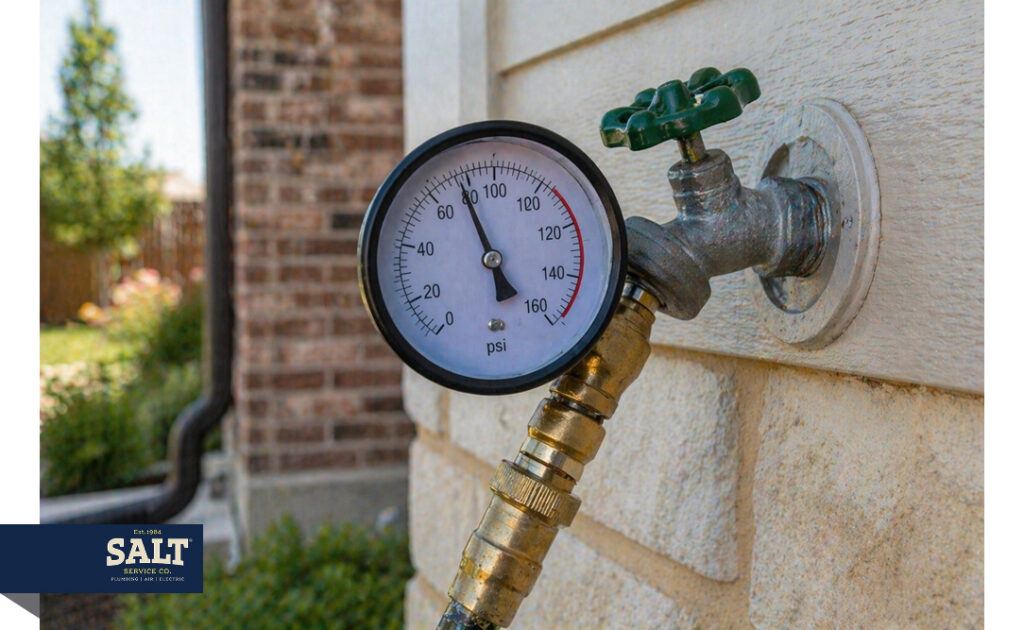
Is your low water pressure a city-wide problem or a single-faucet fluke? Stop guessing — pick up a $10 to $30 hose-bib pressure gauge from any hardware store. Residential pressure runs from 30 to 80 PSI, and most Central Texas homes perform best between 40 and 60 PSI. Anything below 30 PSI makes showering miserable; pressure over 80 PSI can damage appliances and pipes.
Testing the PSI
- Check static pressure: Screw the gauge onto an outdoor spigot. Turn off all indoor faucets and appliances, then open the spigot fully.
- Compare locations: Test at a threaded laundry sink if available. If the outdoor reading is normal but the sink is low, the restriction is inside the home.
Classifying the Issue
- Whole-house: Low readings at all fixtures (under 40 PSI) point to a failing Pressure Reducing Valve (PRV) or a municipal supply issue.
- Localized: If one fixture is weak while the gauge shows normal pressure, check for a clogged aerator or failed cartridge.
- Hot-only: Cold water is strong but hot is weak? Sediment in your water heater or a partially closed valve is the usual cause.
Record your PSI, which fixtures are affected, and whether the drop happens all day or only during peak morning hours.
How to Diagnose Low Water Pressure: A Prioritized Checklist
If every faucet in your home is trickling at once — including the backyard hose bib — you don’t have a single-fixture problem. You have a main line issue. Work through this checklist in order, starting with the quickest fixes.
- Partially closed valves (DIY, 2 minutes): Check your main shutoff valve first. Ball valves are fully open when the lever is parallel to the pipe. Wheel-style gate valves must be turned fully counter-clockwise. A valve bumped during cleaning can easily throttle your home’s flow.
- Failing Pressure Reducing Valve (PRV): This bell-shaped device regulates incoming city water to protect your plumbing. If it fails, pressure may drop or fluctuate wildly. You can adjust the top screw to increase flow, but forcing a stuck PRV risks high-pressure damage.
- Hidden leaks: Turn off all faucets and check your water meter. If the dial moves, you have a leak. Watch for damp spots on drywall or unexplained spikes in your water bill.
- Municipal constraints: If pressure only drops during peak morning hours, the city supply may be struggling. Call your local utility to check for nearby main breaks or neighborhood-wide issues.
- Pipe restrictions and expansion tanks: Hard water in Central Texas causes mineral buildup that clogs older pipes over time. A failed thermal expansion tank on your water heater can also cause odd pressure spikes that feel like low pressure even when your main PSI is technically fine.
How to Fix Low Water Pressure at a Single Faucet or Appliance
If your outdoor PSI test is normal but specific fixtures struggle, you have a localized restriction — not a whole-home issue. Most of these fixes take less than 30 minutes.
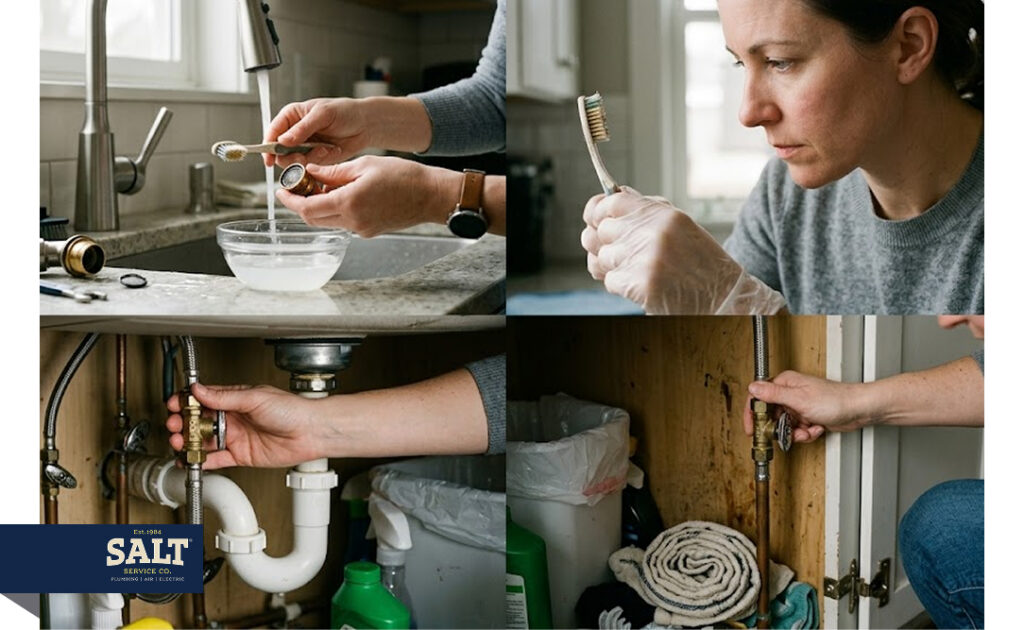
For kitchen or bathroom faucets, unscrew the aerator at the spout tip and rinse out grit or mineral scale. If a showerhead is sluggish, remove it and soak it in white vinegar to clear the nozzles. Modern low-flow fixtures are designed to limit volume — this often feels like low water pressure even when your plumbing system is healthy.
Under the sink, confirm the shut-off valves are turned fully counter-clockwise. If only hot water is weak at a single faucet, or pressure fluctuates when you turn the handle, the internal cartridge is likely clogged with sediment.
For appliances, dishwashers and ice makers need at least 20 PSI to operate correctly. If they fill slowly, check for kinked supply lines or clogged inline filters. Always clean before removing flow restrictors — Central Texas plumbing codes require them.
How to Fix Whole-Home Low Water Pressure: Scenario-Based Plan
Cranking your pressure higher isn’t always the right move. Sometimes the fix is removing a physical restriction — pushing harder risks creating costly leaks. Follow this scenario-based plan to resolve a whole-house pressure drop safely.
- Check valves: Confirm your meter-side and home-side shutoff valves are fully open.
- Replace the PRV: If PSI is inconsistent or stuck low, your Pressure Reducing Valve is likely failing. Professional replacement typically runs $300 to $1,000 depending on accessibility.
- Well owners: Verify switch settings (30/50 or 40/60). With the power off and system drained, set your tank pre-charge to 2 PSI below the cut-in pressure.
- Booster pumps: For chronic low pressure from the municipal supply, ask a professional about constant-pressure or tank-based booster pumps.
Working with electricity and well pumps carries real risks. If these steps don’t restore your flow, call SALT at (737) 386-9507 for a professional plumbing diagnosis.
Your Step-by-Step Plan for Restoring Home Water Pressure
Solving weak water flow requires isolating whether the problem starts before or after the water enters your pipes. Work through this hierarchy to find the most likely fix.
First, test pressure at your outdoor spigot with a gauge. If it reads below 40 PSI, confirm your main valves are fully open. If they are, your utility provider or a failing PRV is the likely cause.
If outdoor pressure is normal, the issue is inside. Clean aerators for single-faucet drops, or inspect your water heater if the problem only affects hot water. Well owners should check the pressure switch and tank pre-charge first.
Call for professional help immediately if you notice a sudden pressure drop alongside wet spots or a water meter that spins while all faucets are off. Those are signs of a hidden leak that can damage your foundation.If you’re in the Austin, Hutto, or Round Rock area and want a licensed plumber to pinpoint the cause, SALT’s team handles everything from PRV replacement to water heater service and whole-home diagnostics.
Frequently Asked Questions
What’s considered low water pressure in a house?
Residential water pressure is low if it falls below 40 PSI. While the functional range runs from 40 to 80 PSI, most fixtures and appliances show problems once pressure dips under 30 PSI. Keep in mind that pressure and flow are different: you might have healthy pressure at the street but low flow inside if mineral buildup is restricting your pipes.
Why did my water pressure suddenly drop all over the house?
A sudden whole-home drop is usually caused by a partially closed main shutoff valve, a municipal water main break, or a significant hidden leak. Check your water meter first — if the leak indicator spins while all faucets are off, you likely have a pipe failure that needs immediate attention. If your valves are fully open and there’s no city alert, your PRV may have failed.
Why is water pressure low in only one shower or faucet?
Almost always a localized clog — aerator screen, showerhead nozzle, or internal cartridge. Hard water deposits collect in the small screens at faucet tips and showerhead openings over time. Soaking the affected part in white vinegar for a few hours dissolves most scale buildup. If cleaning doesn’t work, the mixing valve or cartridge itself may need replacement.
Why is hot water pressure low but cold is fine?
When only hot water is weak, the problem sits at your water heater or the lines leading to it. Sediment accumulates inside the tank and can block the hot water outlet, or the heater’s intake valve may be partially closed. An annual water heater flush restores this for most Austin homes. SALT’s team provides professional water heater maintenance to clear these blockages and verify the tank is running at correct pressure.
Can low water pressure affect my dishwasher or washing machine?
Yes. Most modern appliances need a minimum of 20 PSI to fill and cycle correctly. If pressure is too low, dishwashers won’t clean effectively and washing machines will take significantly longer. Check the small mesh filters where the hoses connect to the unit — they clog with grit over time. Kinked supply lines behind a fridge or washer are another common culprit.
Is it safe to increase water pressure myself?
Cleaning fixtures and opening valves fully is safe. Adjusting the PRV or a well pressure switch carries real risk — pushing your home above 80 PSI can burst pipes, cause faucets to leak, and damage appliance valves. On a well system, mis-setting the pressure switch can burn out your pump motor. Consult a licensed plumber before making mechanical adjustments to your main supply.
Restore Your Water Pressure — or Call the Pros
Most low water pressure problems in a house trace back to one of five causes: a partially closed valve, a failing PRV, mineral buildup, a hidden leak, or a municipal supply issue. Work through the checklist above, and you’ll find the culprit faster than you think.When the fix goes beyond a quick clean or valve turn — PRV replacement, well system work, or a suspected hidden leak — SALT Service Co. has licensed plumbers serving Austin, Round Rock, Hutto, Cedar Park, and the surrounding area. Family-owned since 1984, with flat-rate upfront pricing and a SALT+ membership that covers annual plumbing inspections.