





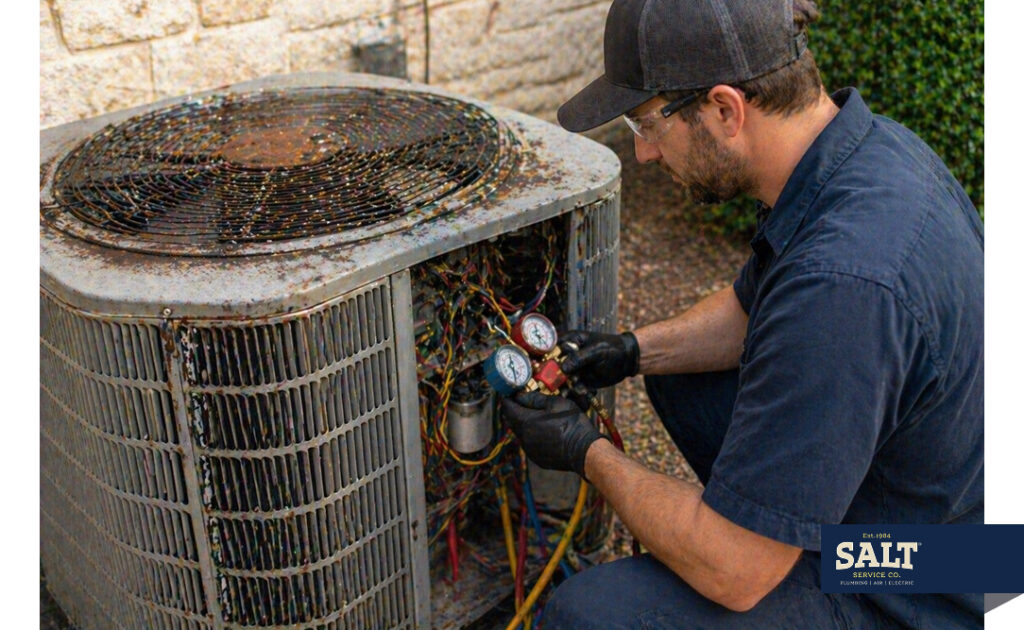
It’s 100 degrees in Central Texas, your vents are blowing lukewarm air, and you’re staring at a repair quote that feels like a down payment. The stress of not knowing whether a fix is a smart investment or just postponing the inevitable is enough to make any Hutto homeowner sweat.
You need a clear decision framework, not a sales pitch. This guide covers the five factors that matter most: equipment age, repair costs, efficiency, refrigerant, and your timeline in the home. We also walk through a simple way to compare the one-time cost of a repair against the monthly payment of a new, high-efficiency system.
As a family-owned Austin team, SALT Service Co. serves the Austin area with upfront pricing and transparent options. We provide the facts so you can choose what is best for your family without the pressure.
Start with the quickest way to tell which direction you’re leaning.
AC Repair vs. AC Replacement: The 60-Second Checklist
Is a quick fix always the smartest move? Spending $500 to repair a 12-year-old unit often ignores the 20% energy savings modern SEER2 systems provide. Focus on the total cost of ownership, not just today’s invoice.
Lean toward Repair if:
- Your system is under 10 years old.
- The repair cost is less than 30% of a replacement quote.
- Your monthly utility bills are stable and comfort is consistent.
Lean toward Replacement if:
- The unit is 12 to 15 years old or uses obsolete R-22 refrigerant.
- You face frequent breakdowns or a major compressor failure.
- Energy bills are rising and indoor humidity is a constant struggle.
This snapshot is a starting point, but an expert diagnosis matters. If you need an honest, same-day assessment in Central Texas, schedule an AC repair visit with SALT Service Co. to see exactly where your system stands.
5 Signs It’s Time to Move from AC Repair to AC Replacement
If you paid $400 for a blower motor in June only to have a capacitor fail during a 105-degree July afternoon, you are trapped in a costly repair loop. In Central Texas, a reliable AC is a safety requirement. When summer temperatures stay in the triple digits for weeks, an aging system becomes a liability rather than a convenience.
Watch for these five high-signal red flags:
- The 12-Year Tipping Point: Texas units run significantly more hours than the national average. Most systems reach a mechanical tipping point between 10 and 15 years.
- Frequent Service Calls: Repairing your unit more than once a year often costs more than monthly financing on a new system.
- Major Component Failure: Compressor or evaporator coil replacements represent major surgery. These repairs rarely justify the investment on an older unit.
- Rising Energy Bills: Increasing monthly costs suggest your system can no longer combat the radiant heat hitting your home.
- Refrigerant Scarcity: Units using R-22 face skyrocketing repair costs due to federal phase-out regulations.
Now, here’s when repairing is still the smart move.
Beyond the 50% Rule: The Total Cost Way to Compare Repair vs. Replacement
Imagine you are quoted $1,800 to repair a 12-year-old unit while a replacement costs $10,000. Most technicians use the 50% rule: replace if the repair cost exceeds half the system’s value. Another gut-check is the $5,000 rule — multiply the unit’s age by the repair quote (12 years × $1,800 = $21,600). Since that far exceeds $5,000, replacement is likely the smarter move.
At SALT, we prefer looking at your monthly cash flow over a five-year horizon. A new SEER2 system can reduce Central Texas cooling bills by 20% to 50% compared to units from a decade ago.
The Monthly Payment Model:
- Repair Quote: Your total immediate cash out.
- Replacement Quote: The monthly payment with financing (e.g., $150).
- Energy Savings: A new unit often saves $40 to $60 monthly in Hutto heat.
- The Net Cost: Subtract your savings from the monthly payment.
If your net cost for a new, warrantied system is $100 per month, it often beats paying for a major repair today and risking another $1,000 fix next summer.
Before deciding, ask your contractor:
- What is the specific warranty on this repair?
- Based on current wear, what else is likely to fail soon?
- How long will this fix realistically last?
If the repair math wins today, visit our AC repair page to get your system back online. If replacement makes more sense, we can walk you through the latest high-efficiency options.
Efficiency and Refrigerant: Why Your AC May Be Costing More Than You Think
Heating and cooling account for roughly 50% of a typical Texas home’s energy use. If your system is over a decade old, you are likely paying a hidden tax through monthly energy waste and rising repair costs.
Modern systems now follow SEER2 standards, which measure real-world efficiency. Upgrading to a new unit can cut cooling costs by 15% to 20% depending on local electric rates and summer usage. Signs that inefficiency is driving your decision include climbing bills and systems that struggle during triple-digit heat.
Refrigerant also shifts the repair vs. replacement math quickly:
- R-22: This is obsolete. If your unit leaks this gas, replacement is almost always the only financial choice because R-22 is prohibitively expensive and scarce.
- R-410A: Currently common but being phased out for newer, lower-GWP refrigerants like R-454B or R-32.
The Verdict: Replace now if you face a major repair or cannot risk a total failure in July. If the system is otherwise healthy and the repair is minor, a fix can bridge the gap while you plan a future upgrade.
If replacement is on the table, the next question is: what should you replace it with?
Choosing Your New System: Two Common Paths for Central Texas Homeowners
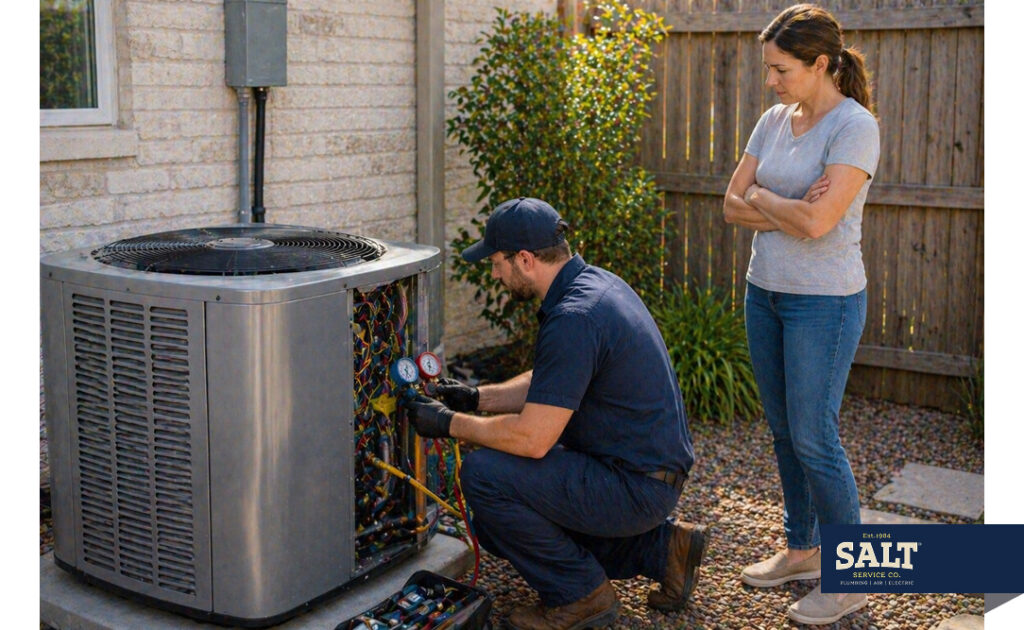
Imagine waking up on a 104-degree Hutto afternoon to a silent thermostat and a $2,000 repair estimate. In this moment, choosing the right replacement path prevents you from repeating this stress in five years.
If you decide to upgrade, you generally have two directions. A like-for-like AC replacement is best if your current ductwork is in good shape and you want a straightforward, reliable unit. Alternatively, a heat pump provides both heating and cooling in one high-efficiency system. These are ideal for the Austin climate and often qualify for federal tax credits.
The quality of the AC installation and precise Manual J sizing matter more than the brand name on the box. To help with affordability, financing converts a large investment into a manageable monthly payment — often less than the constant repair churn of an aging unit. For long-term protection, our SALT+ Membership provides preventive tune-ups, priority scheduling, and a 10% discount on repairs to keep your new system running at peak efficiency.
Your 5-Step Plan for the Repair vs. Replacement Decision
Deciding whether to patch up an old unit or invest in a new one involves more than just the immediate price tag. It is a balance of current cash flow, long-term energy savings, and your family’s comfort during a 100-degree Austin afternoon. When you look at the math over a five-year horizon, the hidden tax of an aging, inefficient unit often exceeds the monthly cost of a modern, warrantied system.
Follow this framework to make a confident choice for your home:
- Check the facts: Confirm the unit’s age, refrigerant type (R-22 vs. R-410A), and remaining warranty status.
- Get a repair diagnosis: Request a written quote that explains the root cause of the failure.
- Price the upgrade: Get a replacement estimate that includes monthly financing options for comparison.
- Calculate the math: Compare the repair cost against projected energy savings and the value of a new 10-year warranty.
- Assess the risk: Consider your tolerance for a total mechanical breakdown during peak Central Texas summer heat.
If you are leaning toward a fix, our team provides reliable AC repair. If it is time for a fresh start, we offer transparent replacement quotes for systems built for Texas. To prevent future surprises, consider a SALT+ membership for year-round protection and peace of mind.
Frequently Asked Questions
Should I repair or replace my AC if it is 10 to 15 years old?
At this age, prioritize replacement if you face a major repair exceeding $1,000. While minor fixes like capacitors are fine, the risk of a secondary failure during a Central Texas summer is high. Most units in the Austin area reach their mechanical limit after 12 years due to high runtime. Upgrading now gives you a full manufacturer warranty and significantly higher energy efficiency.
Why do AC replacement quotes vary so much between different companies?
Differences in pricing usually stem from the equipment efficiency tier, the inclusion of ductwork repairs, and the level of labor quality. A high-efficiency SEER2 unit costs more upfront than a base model but lowers monthly utility bills significantly. Compare itemized quotes to confirm that permits, refrigerant, and electrical upgrades are included. SALT Service Co. provides transparent, upfront pricing to help eliminate this guesswork for local families.
Should I wait to replace my AC because of the new refrigerant regulations?
Do not wait if your current system is failing or requires an expensive repair. While the industry is shifting toward newer refrigerants, systems using R-410A will be supported with parts and service for many years. Waiting for the latest technology often leads to emergency replacement costs during peak summer heat when prices and service demand are at their highest.
Can I replace just the outdoor unit instead of the whole system?
You can, but it is rarely recommended. Mismatched indoor and outdoor components often void warranties and reduce efficiency. Modern outdoor units are designed to communicate specifically with matched indoor air handlers to achieve their rated SEER2 performance. Installing a partial system usually leads to premature mechanical failure and higher energy bills. A professional contractor should always evaluate both units to confirm compatibility.
Does homeowner’s insurance cover the cost of a new air conditioner?
Most standard policies only cover AC replacement if the damage was caused by a specific covered peril — such as a fire, lightning strike, or a falling tree. Insurance does not cover systems that fail due to age, general wear and tear, or lack of maintenance. If you face a sudden replacement, SALT Service Co. offers flexible financing options, including 0% interest for 18 months, to help manage the unexpected investment.
What is the fastest way to get an AC diagnostic in the Austin or Hutto area?
The quickest way to get help is to book a diagnostic visit online or call for same-day service. SALT+ members get priority scheduling to keep turnarounds fast during Texas heat waves. Booking a professional assessment immediately prevents a small mechanical issue from turning into a total system failure that requires a much more expensive replacement.
When you weigh the full picture — unit age, repair frequency, efficiency loss, and the risk of a summer breakdown — the right call between AC repair vs. AC replacement usually becomes clear. SALT Service Co. gives you the honest diagnosis and transparent pricing to make that call with confidence.