






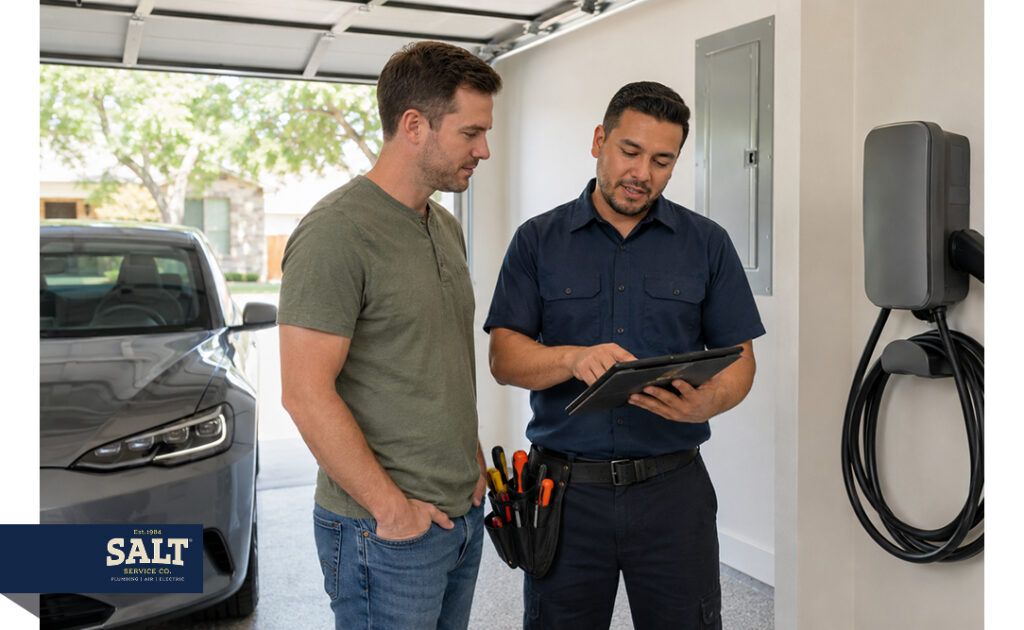
You finally brought home a new EV, but the novelty fades the third time you are sitting in a grocery store parking lot at 9 PM just to get enough charge for tomorrow’s commute. Public charging works in a pinch, but it is not a sustainable long-term solution.
For most Austin homeowners, true freedom starts in the garage. A reliable EV charger installation at home involves more than a mounting bracket. You need to navigate panel capacity, city permits, and the industry shift between J1772 and NACS (Tesla-style) connector standards.
This guide provides a clear roadmap for your project. We cover typical Central Texas costs, how to avoid expensive panel upgrades with load management, and how to stay code-compliant. As licensed electricians serving Austin since 1984, SALT Service Co. prioritizes your home’s safety over a quick sale.
Here is what you actually gain from a dedicated home Level 2 setup.
Why a Level 2 EV Charger Installation at Home Is Worth It
A standard 120V outlet adds about 4 miles of range per hour. For most Austin drivers, that is not enough to recover a full daily commute overnight. Upgrading to a Level 2 station changes your EV experience from a daily chore into a seamless routine by using 240V power to fully charge your vehicle while you sleep.
Key homeowner benefits:
- Lower utility bills: Schedule sessions for 2 AM to take advantage of off-peak time-of-use rates.
- Zero friction: Skip the lines and broken pedestals at public charging stations.
- Electrical safety: A dedicated circuit handles continuous high-load draws safely. Standard household outlets can overheat during a 12-hour charging session.
- Battery longevity: Consistent Level 2 charging is gentler on your battery than high-heat DC fast chargers.
You might skip the upgrade if you drive under 30 miles daily or have reliable workplace charging. Otherwise, professional EV charger installation at home confirms your system is safe, code-compliant, and ready every morning.
J1772 or NACS? Choosing an EV Charger Built for Today’s Standards
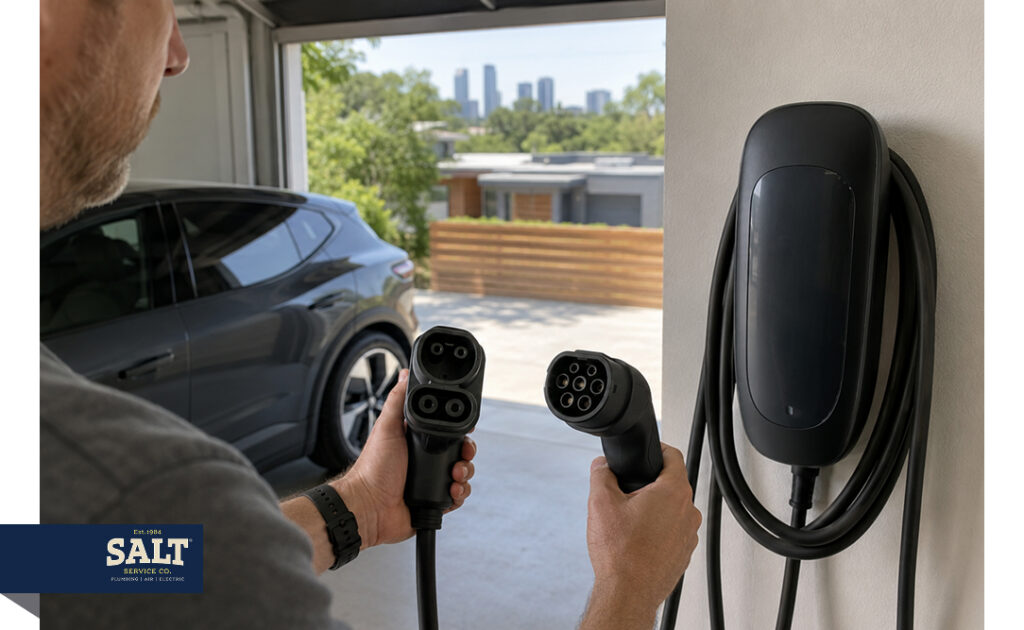
Deciding between a Tesla-style NACS connector and the standard J1772 plug is simpler now that Ford, GM, and Hyundai have switched to the North American Charging Standard (NACS). Many Austin homeowners still worry about compatibility, particularly if they own a non-Tesla vehicle from before the transition.
The choice depends on your daily routine. Match the connector to your current car’s port for the best experience. If you live in a mixed-EV household or plan to upgrade vehicles soon, a universal charger with an integrated adapter prevents the frustration of searching for a loose adapter during a busy morning.
When choosing a unit for a Central Texas home, prioritize these technical features:
- Hardwired capability: More reliable and better suited for Austin garage heat than plug-in models.
- Adjustable amperage: If your panel is nearly full, a unit you can dial down (from 48A to 32A) can often save you the cost of a full panel upgrade.
- Weather rating: A NEMA 4 rating is required for outdoor or driveway installations.
- 25-foot cable: This length reaches the charging port regardless of how you park.
Once the charger is selected, your home’s electrical system determines what is actually possible.
Technical Requirements: Preparing Your Electrical Panel for EV Charger Installation at Home
Unboxing a new $500 charger only to find that labor and materials cost four times more is a common surprise. Most cost overruns for EV charger installation at home come from the electrical wiring and infrastructure, not the charging unit itself.
To support Level 2 charging, your home needs a dedicated 240V circuit. Our team evaluates your service size before recommending any work. A 100A panel is common in older Austin homes but rarely has the headroom for an EV once the AC and an electric oven run at the same time. A 200A panel is the current standard and provides the spare capacity needed to add a 50A or 60A breaker without overloading your system.
You will also choose between a hardwired connection or a NEMA 14-50 plug. Hardwiring is generally preferred for Austin garages because it supports higher power output (48A) and removes the plug as a potential failure point. Plug-in models offer portability but require industrial-grade receptacles to prevent overheating during six-hour charging sessions.
If your panel is at capacity, a full service upgrade may not be necessary. We often recommend an EV Energy Management System (EVEMS). This smart device monitors your home’s total power usage in real time. When you run a high-demand appliance, the EVEMS automatically throttles the charger to prevent a tripped breaker, then returns to full speed once the load drops, typically overnight. Professional installation also confirms correct conductor sizing and torque specs, which are critical for preventing terminal damage or nuisance trips common in DIY installs.

What Does EV Charger Installation at Home Actually Cost in Austin?
Most Austin homeowners invest between $1,200 and $2,800 for a professional Level 2 home EV charger installation. That total breaks down into three categories: charger hardware ($400 to $800), electrical labor and materials, and city permits or inspections.
Distance is the primary cost driver. A five-foot run next to your electrical panel costs significantly less than a fifty-foot run through a finished attic or crawlspace. Outdoor driveway installations also add cost because they require weather-rated conduit and trenching. If your panel is at capacity, load management hardware can often bypass a $2,000 service upgrade while keeping your home safe.
Itemized quote checklist:
When reviewing quotes, confirm these details are included:
- Charger model: Specify whether it is SALT-provided or customer-supplied.
- Amperage: The specific setting for the install (e.g., 40A or 48A).
- Installation scope: Estimated run length and wiring method.
- Compliance: Confirmation that Austin permits and inspections are included.
- Infrastructure: Any necessary panel work or load management devices.
Local incentives can offset these costs. Austin Energy currently offers a rebate covering 50% of the cost, up to $1,200, for smart chargers installed by a licensed contractor with a closed permit. The Federal 30C tax credit provides up to $1,000, though eligibility is restricted to specific census tracts. Check official guidance before counting on federal credits.
To get a professional estimate, view our electrical services and let our family help yours.
What to Expect on EV Charger Installation Day
When the SALT Service Co. truck pulls into your driveway, you want to be ready. A wire run through the attic with the access hatch blocked by holiday decorations can delay the whole job. This walkthrough confirms your installation day goes smoothly.
Our step-by-step process includes:
- Pre-assessment: Finalizing wiring routes and verifying panel capacity.
- Permitting: We handle paperwork for Austin and Central Texas municipalities.
- Install: Running conduit, mounting the unit, and connecting the breaker.
- Commissioning: Setting max amperage and syncing app connectivity.
- Testing: A live charge test and labeling your electrical panel.
- Documentation: Providing records for inspections and local rebates.
To prepare, clear the garage wall and provide attic access if needed. Have your Wi-Fi password ready for smart-enabled chargers. If you are considering solar or bidirectional charging (V2H) later, ask about upsized conduit now. Planning ahead is far cheaper than rewiring later.
Choosing the Right EV Charging Strategy for Your Central Texas Home
Successful home charging depends less on the hardware brand and more on your electrical panel’s capacity. Balancing connector standards with available local rebates helps you avoid the two most expensive mistakes: buying an obsolete plug or paying for a $2,000 panel upgrade you do not actually need.
Use this 6-point plan to finalize your strategy:
- Confirm your port needs: Match your current connector to your likely next vehicle when choosing between NACS and J1772.
- Map the cable reach: Choose an installation spot based on daily parking habits, cable length, and weather exposure.
- Audit your electrical panel: Get a professional capacity evaluation rather than guessing on your home’s headroom.
- Request load management: Ask about smart hardware that throttles charging during peak use. This often eliminates the need for a full service upgrade.
- Compare itemized quotes: Confirm permits, specific materials, and wall patching expectations are listed before you sign.
- Check incentive eligibility: Gather rebate paperwork for Austin-area programs before installation day to confirm compliance.
If you want a licensed electrician to walk you through options and pricing, schedule a visit with the SALT Service Co. team.
Frequently Asked Questions
Do I need a permit to install a Level 2 charger at home in Austin?
Yes. The City of Austin and most surrounding municipalities require an electrical permit for Level 2 charger installations. The permit triggers a professional inspection confirming the new circuit meets National Electrical Code standards. A closed permit is also required to qualify for Austin Energy rebates and to maintain homeowner’s insurance compliance.
What is the typical EV charger installation cost in Austin, TX?
Most Austin homeowners spend between $1,200 and $2,800 for a professional Level 2 installation, including the charging hardware. The final price depends on the distance between your panel and the charger location. SALT Service Co. provides itemized quotes that separate labor, materials, and permit fees from the equipment cost.
Can I avoid a panel upgrade with load management (EVEMS)?
Yes. An EV Energy Management System often allows you to add a high-speed charger on a limited 100A or 125A panel. These smart devices monitor real-time power consumption and automatically throttle the charger when you run a heavy appliance. This technology can save over $2,000 by eliminating the need for a full electrical service upgrade.
Should I install a NACS or J1772 charger in my garage?
Install the connector that matches your current vehicle’s port. The industry has largely shifted to NACS (the Tesla standard). If you own a Tesla, NACS is the clear choice. For other brands, J1772 is still current, but many homeowners now choose universal chargers with built-in adapters to future-proof their setup for the next generation of EVs.
Is it better to hardwire a charger or use a NEMA 14-50 outlet?
Hardwiring is the preferred method for home installations. It supports higher power output (48A versus 40A for plug-in NEMA 14-50) and offers better long-term reliability. Hardwiring also removes the outlet as a potential failure point, which matters in Texas garages where sustained high temperatures put extra stress on electrical connections.
Are there EV charger benefits even if I only drive 20 to 30 miles a day?
Yes. A Level 2 charger provides safety and efficiency benefits a standard wall outlet cannot match. While a 120V outlet can recover 30 miles of range, it runs at maximum capacity for nearly eight hours, stressing older household wiring. A Level 2 station handles the same task in about an hour, reducing wear on your home’s electrical system.
Ready to Stop Relying on Public Charging?
A well-planned EV charger installation at home pays off quickly through saved time, lower charging costs, and the confidence that your car is fully charged every morning. The key is matching your panel capacity to the right charger and taking advantage of Austin Energy rebates before they change. SALT Service Co. has been helping Austin homeowners with electrical upgrades since 1984. Call (737) 386-9507 or request an estimate online.